You prepared the questions. You know the definitions. You even practiced answering "Tell me about yourself" in front of a mirror.
Then the interviewer asks something slightly different.
For example, instead of asking "What is a JOIN in SQL?", they give you two tables and ask you to write a query. Or instead of asking "What is inheritance in Java?", they ask where you have actually used it in your project.
This is where many freshers get stuck.
An IT interview is not only about how many questions you can remember. The interviewer also wants to see whether you understand what you have learned, how you approach a problem, and whether you can explain your answer in a simple way.
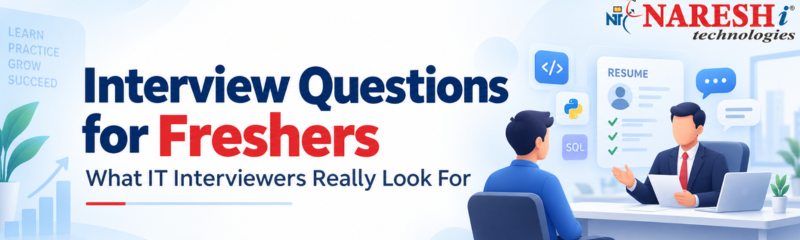
That is what this article focuses on. These Interview Questions for Freshers are not just questions to memorize. They are examples of what an interviewer may be trying to understand from your answer.
Imagine two candidates are asked the same question:
"What is a primary key?"
The first candidate says:
"A primary key is a constraint that uniquely identifies each record in a table and cannot contain NULL values."
Technically, that's fine.
The second candidate says:
"A primary key is used to identify each row uniquely. For example, in a student table, student_id can be the primary key because every student should have a different ID."
The second answer is easier to understand and shows that the candidate knows how the concept works.
This is an important difference during an interview.
Interviewers are usually looking at things such as:
Do you understand your basics?
Can you explain something without simply repeating a definition?
Can you solve a small problem?
Do you know the technologies mentioned on your resume?
Can you explain your project?
What do you do when you don't know something?
Can you communicate your thoughts clearly?
You don't need to know everything.
But if you have written Java, Python, SQL, React or any other technology on your resume, you should be ready to answer questions about it.
Some HR Interview Questions for Freshers are simple, but that doesn't mean you should ignore them.
You may be asked:
Tell me about yourself.
Why did you choose IT?
Why are you interested in this role?
Tell me about your project.
What are your strengths?
What is one skill you are currently improving?
Why should we hire you?
Are you comfortable learning a new technology?
Tell me about a problem you faced during your project.
Don't memorize a five-minute speech for these questions.
Take "Tell me about yourself."
A simple answer can follow this order:
Education → Technical skills → Project → What role you are looking for
For example:
"I completed my B.Tech in Computer Science. I have been learning Python, SQL and Django, and recently worked on a student management project. I mainly worked on the backend and database part. I'm now looking for a software development role where I can continue improving my programming skills."
That's enough to start a conversation.
The interviewer can then ask about your project or your technical skills.
Technical interviews can cover different subjects depending on the job.
For a developer role, you may get questions on programming, databases, APIs, Git, OOP and basic web concepts.
For a Java position, expect Java Interview Questions around OOP, collections, exceptions, strings and related frameworks mentioned in the job description.
For Python roles, revise Python basics, functions, data structures, OOP, exceptions and the framework you're using.
For database-related questions, SQL Interview Questions are very common.
Suppose you have this table:
employees
id | name | department | salary
1 | Ravi | IT | 45000
2 | Priya | HR | 40000
3 | Arjun | IT | 55000
The interviewer asks:
"Write a query to find employees from the IT department."
A simple answer is:
SQL:
SELECT name, salary
FROM employees
WHERE department = 'IT';
But don't stop after writing the query.
You should be able to explain:
"I'm selecting the name and salary from the employees table and filtering the rows where the department is IT."
That explanation takes a few seconds and shows that you understand the query.
"How do you find the highest salary?"
SQL:
SELECT MAX(salary)
FROM employees;
An interviewer may then ask:
"What if I want the employee name also?"
That's where the conversation becomes more interesting. You may need to think about ordering, a subquery, or another approach.
This is why practicing only one-line answers isn't enough.
You don't always get difficult coding problems in a fresher interview.
Sometimes the interviewer starts with something very basic.
For example:
"Write a program to find whether a number is even or odd."
Python:
number = 10
if number % 2 == 0:
print("Even")
else:
print("Odd")
The interviewer may then ask:
"Why are you using %?"
A fresher who understands the code can answer:
"The % operator gives the remainder. When a number is divided by 2, an even number gives a remainder of 0."
Now imagine the interviewer changes the question:
"How would you check this for 10 numbers?"
You can modify your approach using a loop.
The important part is not just getting the code right. Explain what you are doing as you work.
Python:
name = "Python"
print(name[0])
What will be printed?
Answer:
P
An interviewer may follow up with:
"Why does name[0] give P?"
You should know that Python uses indexing, and the first character is at index 0.
These small follow-up questions are common because they show whether you understand the code or simply memorized it.
Before typing immediately, take a few seconds.
Think about:
What exactly is the problem?
What input are we getting?
What output is expected?
What approach can I use?
Are there any special cases?
If you get stuck, explain your thinking instead of sitting silently.
Your project is one of the easiest places for an interviewer to start asking follow-up questions.
Suppose your resume says:
"Developed an online shopping application using Python, Django, React and MySQL."
Don't be surprised if the interviewer asks:
"Why did you use Django?"
Then:
"How does your frontend communicate with the backend?"
Then:
"How did you store user information?"
Then:
"How did you handle login?"
And finally:
"What was the biggest problem you faced?"
One answer can lead to five more questions.
So prepare your project properly.
You should know:
Why you selected the technologies
What your role was
How the application works
How the database is connected
How APIs are used
How login or authentication works, if included
What problems you faced
How you solved at least one real problem
What you would change if you built it again
Don't claim that you built something you don't understand.
If you worked only on the database, say that. If you worked on the backend, explain the backend properly.
Being clear about your contribution is better than trying to sound like you handled everything.
The type of IT Interview Questions for Freshers you receive depends heavily on the position.
A Java developer and a DevOps candidate shouldn't prepare in exactly the same way.
|
Role |
Areas to Practice |
|
Java Developer |
Java, OOP, SQL, Spring/Spring Boot, REST APIs, coding |
|
Python Developer |
Python, OOP, SQL, Django/Flask, APIs, coding |
|
Software Developer |
Programming, SQL, APIs, Git, debugging, problem-solving |
|
Data-related Role |
SQL, Python, statistics and data concepts |
|
DevOps Role |
Linux, Git, networking, Docker, CI/CD and cloud basics |
This doesn't mean you need to learn everything listed above.
Start with the job you're applying for.
If the job description says Java + SQL + Spring Boot, spending most of your preparation time on random cloud services probably isn't the best use of your time.
Read the job description carefully and make your preparation around it.
This situation will happen.
You may get a question about a topic you have never studied.
Don't try to create an answer while hoping the interviewer won't notice.
You can simply say:
"I haven't worked with that concept yet, so I'm not confident enough to give you the correct answer."
That's much better than giving an incorrect technical explanation.
If you know something related, mention it.
For example:
"I haven't used Docker in a real project yet, but I understand that containers package an application and its dependencies so it can run in a consistent environment."
You haven't pretended to be an expert, but you've shown that you know the basic idea.
Sometimes the interviewer may give you a hint or ask a related question. Listen carefully and work through it.
An interview is also about how you handle a question when you don't immediately know the answer.
Don't spend the night before your interview trying to read 500 Interview Questions and Answers.
You probably won't remember most of them.
Instead, prepare in a way that matches the actual interview.
Go through the important topics from your programming language, SQL, OOP, data structures and other subjects related to your role.
Read every line.
If you have written:
Python, SQL, Django, Git
prepare questions around all four.
If you have mentioned a project, prepare for detailed questions about it.
Don't just watch coding videos.
Write small programs.
Try questions involving:
Strings
Arrays/lists
Numbers
Loops
Functions
Basic sorting/searching
Simple SQL queries
Try explaining your project without looking at your notes.
If you can't explain it in simple language, you probably need to revise it.
This is one of the best ways to prepare.
If your answer is:
"I used MySQL."
Ask yourself:
Why MySQL?
If you say:
"I created an API."
Ask:
What does the API do?
How does the frontend call it?
How do you handle errors?
This kind of practice is much closer to a real interview than memorizing a question list.
Preparing for an IT interview doesn't mean memorizing hundreds of questions.
Know your basics. Practice writing code. Understand the technologies on your resume. Most importantly, know your project well enough to explain what you actually did.
When you get a question you haven't seen before, don't panic. Take a moment, understand the question and explain how you would approach it.
That habit will help you far beyond your first interview.
Which part of an IT interview do you find most difficult: coding questions, technical questions, HR questions, or explaining your project?
Follow NareshIT for more practical insights on technology, skills, and career development.
1. What are the most important interview questions for freshers?
Start with questions about yourself, your project, programming basics, SQL, OOP, coding and the technologies mentioned on your resume. The exact questions depend on the role.
2. Should freshers memorize interview answers?
It's better to remember the main points instead of memorizing complete answers. This makes your response sound more natural and helps you handle follow-up questions.
3. How much coding should a fresher practice?
Practice small problems regularly before moving to difficult questions. Strings, arrays, loops, functions, numbers, basic data structures and simple SQL queries are good starting points.
4. What should I prepare about my project?
Know your project's purpose, your contribution, technologies used, database design, APIs, important features, problems you faced and how you solved them.
5. What should I do when I don't know an interview question?
Be honest. Tell the interviewer that you haven't worked with the topic yet. If you know a related concept, explain what you do know rather than guessing.
 +91 8179191999
 support@nareshit.com
  +91
8179191999
+91
8179191999
 support@nareshit.com





.png)