.png)
Next Batch : Invalid Date
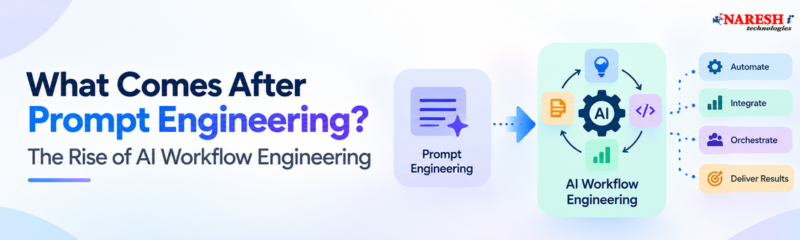
Writing the perfect prompt was never the finish line it was the entry point. Here's what the next skill actually looks like.
Two years ago, "prompt engineering" was treated like a superpower. Learn the right phrasing, the right examples, the right structure, and you could get dramatically better output from an AI model. Courses were built around it. Job titles included it. For a while, it genuinely was the skill that separated people getting real value from AI from people getting mediocre results.
That skill hasn't disappeared, but it has quietly stopped being the ceiling. As models have gotten better at inferring intent from ordinary language, the advantage of crafting a perfectly worded single prompt has shrunk. What hasn't shrunk is the challenge of getting AI to reliably complete a real, multi-step piece of work and that's a different problem entirely.
This is the gap that AI workflow engineering is stepping into. It's not a rebrand of prompt engineering, and it's not a claim that prompting no longer matters. It's a recognition that a single well-crafted question was never going to be enough to run an actual business process, and the industry is now building the discipline to do that properly.
Prompt engineering is the practice of crafting inputs to a language model so it reliably produces useful output understanding how a model reasons, how phrasing shifts its behavior, and how examples steer its responses. At its best, it's a genuine skill: knowing how to reduce ambiguity, guide tone, and structure a request so the model doesn't have to guess what you actually want.
The important thing to understand is that this skill isn't obsolete. It's foundational but foundational is not the same as sufficient.
A single prompt, however well-written, produces a single response. It doesn't check whether that response is correct. It doesn't hand the output to a second step. It doesn't retry when something fails. It doesn't remember what happened in a related task an hour ago.
That was manageable when AI use cases were simple: one model, one prompt, one answer. It stops being manageable the moment a real task involves multiple steps, multiple tools, or multiple systems which is most real work. Ask yourself: how many tasks in your actual job are genuinely "one question, one answer"? Most aren't.
AI workflow engineering is the discipline of designing multi-step systems where AI models reliably complete real work not by writing one perfect instruction, but by architecting how a task moves from input to verified, usable output.
Where prompt engineering asks "how do I phrase this so the model understands me?", workflow engineering asks a different set of questions:
This is closer to systems design than copywriting. You're not optimizing a sentence you're designing a process, with checkpoints and failure handling built in.
A useful way to see the shift is to compare a single prompt call to a designed workflow.
python
# Prompt engineering: one call, one output, no verification
def get_answer(prompt):
    return model.generate(prompt)
# Workflow engineering: a designed multi-step process
def run_workflow(task):
    context = gather_context(task)          # pull relevant data, docs, prior state
    plan = decompose_into_steps(task)
    results = []
    for step in plan:
        output = execute_step(step, context, tools)
        if not verify(output, step.criteria):
            output = retry_or_escalate(step, output)   # retry, adjust, or flag for a human
        results.append(output)
        context = update_context(context, output)      # pass state to the next step
    return assemble_final_output(results)
Notice what's different: the workflow version has explicit steps for gathering context, verifying output, handling failure, and passing state forward. None of that exists in a single prompt call and all of it is where real-world reliability actually comes from.
A few terms are circulating alongside "AI workflow engineering," and it helps to know how they relate rather than treat them as competing buzzwords:
These aren't separate disciplines competing for the same job title they're pieces of the same underlying shift: from optimizing one interaction to designing a reliable process.

Task: "Review this batch of customer support tickets and draft responses for the ones about billing issues."
Prompt engineering approach: You write a detailed prompt describing the tone, the billing policy, and the format you want, then paste in tickets and review each response manually re-prompting whenever the tone or facts are off.
Workflow engineering approach: A workflow first classifies tickets by topic, retrieves the current billing policy as context for only the billing-related ones, drafts responses with a verification step that checks the response against policy facts, flags any response with an inconsistency for human review, and only then queues the confirmed drafts for sending.
The underlying model doing the writing might be identical in both cases. What changed is the process wrapped around it and that process is exactly what determines whether the result is reliable at scale.
Benefits:
Limitations:
"Prompt engineering is dead, so I don't need to learn it." Not accurate writing clear, precise instructions is still the foundation of every step inside a workflow. Workflow engineering builds on that skill, it doesn't remove the need for it.
"More steps in a workflow always means better results." Not necessarily. Added complexity without verification just gives an error more places to hide. Simple tasks often don't need an elaborate workflow at all.
"Workflow engineering is only for engineers building AI products." Increasingly, this is a mindset useful to anyone designing a repeatable process marketing operations, customer support, data analysis not only software teams.
For students and freshers, keep building core prompt-writing skills, but pair them with basic systems thinking: practice breaking a vague goal into concrete, checkable steps. That habit transfers directly into workflow design.
For working professionals and career switchers:
Job postings that once specified "prompt engineer" are increasingly folding that skill into broader titles AI workflow designer, automation engineer, or simply "AI-fluent" as a baseline expectation within an existing role. The distinguishing skill in interviews and on the job is shifting from "can you write a good prompt" to "can you design a process that produces reliable results consistently."
For freshers: this is good news, not bad. It means the deeper skill being asked for clear thinking, breaking problems into steps, and building in verification is the same skill good engineers have always needed, with AI as the new medium.
Expect the terminology here to keep shifting you'll see workflow engineering discussed alongside orchestration, context engineering, and other emerging labels as the field settles on shared vocabulary. That's normal for a fast-moving area; the underlying shift matters more than which name sticks. What's consistent across all of these framings is the same core idea: value is moving from optimizing a single interaction to designing a dependable process.
Where do you think the boundary should sit how much of a workflow should run autonomously before a human needs to check in?
No. It's still foundational every step in a workflow relies on clear instructions. It's just no longer sufficient on its own for complex, multi-step work.
Designing a multi-step process where AI reliably completes real work, including how it gets context, verifies output, and handles failures rather than relying on one prompt for one answer.
Not necessarily. The core skill is breaking a task into clear steps with checkpoints; many workflow tools let you do this without writing code.
Context engineering focuses on what information a model receives and when. Workflow engineering is the broader process design steps, verification, and handoffs that context engineering feeds into.
It's becoming less common as a standalone title, with the skill increasingly folded into broader roles like AI workflow designer or automation engineer.
Errors compounding silently across steps when there's no verification built in a flawed early step can carry through to a confidently wrong final output.
Pick a task you currently solve with a single prompt, break it into steps, and add at least one point where the output gets checked before moving forward.
Prompt engineering taught people how to ask AI better questions. AI workflow engineering is about building systems that don't just answer once, but reliably carry a real task through to a verified, usable result. Neither replaces the other workflow engineering is built on prompting fundamentals, applied at a bigger scale.
Takeaway: Pick one task you currently hand to AI in a single prompt, and try turning it into a small workflow with one verification step. That single exercise will teach you more about this shift than reading a dozen articles about it.
Follow NareshIT for more practical insights on technology, skills, and career development.
 +91 8179191999
 support@nareshit.com
  +91
8179191999
+91
8179191999
 support@nareshit.com



.png)





.png)